

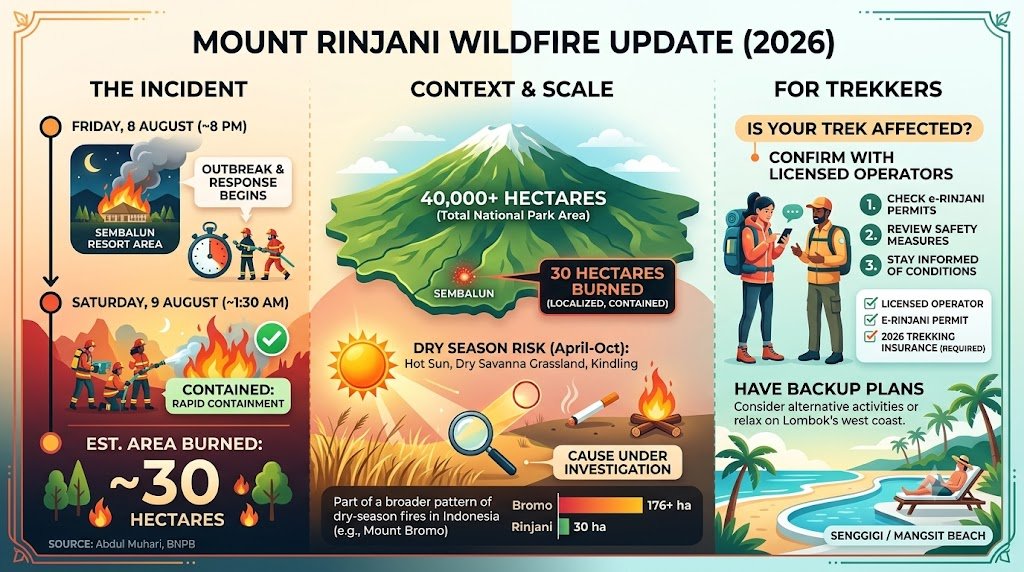
A Mount Rinjani wildfire broke out on the volcano’s northern slopes late last week, and if you’re planning a trek anytime soon, you’ve probably already seen the headline and wondered how worried to be. Here’s the honest, fact-checked version: a fire did burn through part of the Sembalun area, it was brought under control within hours, and here is exactly what happened.
What actually happened with the Mount Rinjani wildfire
At around 8pm on Friday, 8 August 2026, a forest and land fire broke out in the Sembalun Resort area of Mount Rinjani National Park, in East Lombok Regency — the same highland district that hosts the classic Sembalun summit trailhead. By roughly 1:30am on Saturday, 9 August, firefighting teams had it under control, having burned through an estimated 30 hectares. That’s a fast response for a nighttime forest fire on volcanic terrain, and it’s worth sitting with that number for a second: thirty hectares sounds significant until you remember Rinjani National Park itself covers over 40,000 hectares. This was a contained, localised incident, not an inferno swallowing the mountain.
The update came from Abdul Muhari, spokesperson for Indonesia’s National Disaster Management Agency (BNPB), who confirmed the containment time and area burned. What sparked it is still under investigation, and BNPB hasn’t released a cause as of this writing.
Is this part of something bigger?
Sort of, and it’s useful context. The Sembalun fire broke out during a stretch of dry-season fires across Indonesia’s volcanic regions — Mount Bromo in East Java, for instance, has been fighting a much larger blaze of over 176 hectares since Monday, 5 August. Dry season (roughly April to October) is exactly when this kind of fire risk rises across the archipelago, Rinjani included, simply because vegetation on these slopes dries out fast under months of unbroken sun.
None of this is unique to 2026, and it doesn’t mean the mountain is somehow more dangerous than usual. It does mean that if you’re trekking during peak dry season, a little extra awareness of trail conditions — and a guide who’s actually up to date on the park’s status — goes a long way.
What this means if you have a Rinjani trek booked
As of publication, there’s no official word that the fire affected trekking permits, trail access, or the e-Rinjani permit system — the Sembalun trailhead itself sits apart from the resort area where the fire burned. That said, park conditions can shift quickly after any fire, however contained, so the sensible move if you’ve got a summit attempt coming up is simple: confirm directly with your licensed trekking operator in the days before you go, rather than assuming everything’s exactly as it was when you booked.
If your trip has any flexibility built in, it’s also worth having a backup plan for the days around your trek. Plenty of climbers now bookend a Rinjani summit with a couple of nights on the calmer west coast — the stretch of beachfront around Senggigi and Mangsit is where a lot of trekkers land before an early Sembalun start, and it’s equally popular afterward, when a pool and a proper bed matter more than anything else. A beachfront stay in the long-established Mangsit strip makes a comfortable landing spot either side of the mountain, fire season or not.
Why dry-season fires happen on Rinjani at all
Rinjani’s slopes are covered in savanna grassland lower down and dense forest higher up, and by August — four or five months into the dry season — that grassland is essentially kindling. A dropped cigarette, an untended cooking fire, or even the sun catching a piece of glass at the wrong angle can be enough to start something that spreads fast in wind and slow-burns through the night, which lines up with how this particular fire behaved: a slow start after dark, a hard-fought containment before dawn.
It’s also worth knowing that Indonesia’s park authorities and disaster agencies have gotten notably faster at responding to these incidents in recent years, partly because Rinjani’s tourism economy depends on it. A fire that might have burned for days a decade ago now gets a coordinated response within hours, which is exactly what happened here.
None of this changes the basics for a safe trek: register through a licensed operator, carry the trekking insurance now required under the park’s 2026 rules, and treat any fire near the trail — controlled or not — as a reason to double-check conditions rather than a reason to cancel outright.
Frequently asked questions
When did the Mount Rinjani wildfire happen?
The fire broke out around 8pm on Friday, 8 August 2026, in the Sembalun Resort area of Mount Rinjani National Park, and was brought under control by about 1:30am the following morning.
How much of Mount Rinjani burned?
An estimated 30 hectares in the Sembalun Resort area — a contained, localised fire, not a threat to the wider 40,000-plus hectare national park.
Is Mount Rinjani still open for trekking?
There has been no official announcement that the fire affected trekking permits or trail access. Trekkers with an upcoming trip should confirm current conditions with their licensed operator before departure.
Source: The Star