

We write about the Gili Islands a lot on this site — the turtles, the car-free streets, the water so clear it barely looks real. All of that is still true. But a honest travel site also tells you when the picture is more complicated, and the Gili Islands coral reef is where that complication is showing up first. A peer-reviewed study on overtourism in Bali and Lombok, along with reporting from dive operators on the ground, points to real environmental strain building up around the islands that made this stretch of coast famous in the first place.
What we know about the Gili Islands coral reef
A 2026 academic study published in the journal Societies, examining governance and community impacts of overtourism across Bali and Lombok, flags the Gili Islands and Senggigi as areas showing “parallel strains” to Bali’s more widely reported tourism pressure — environmental degradation and social disruption moving at a pace the islands’ infrastructure was not built for.
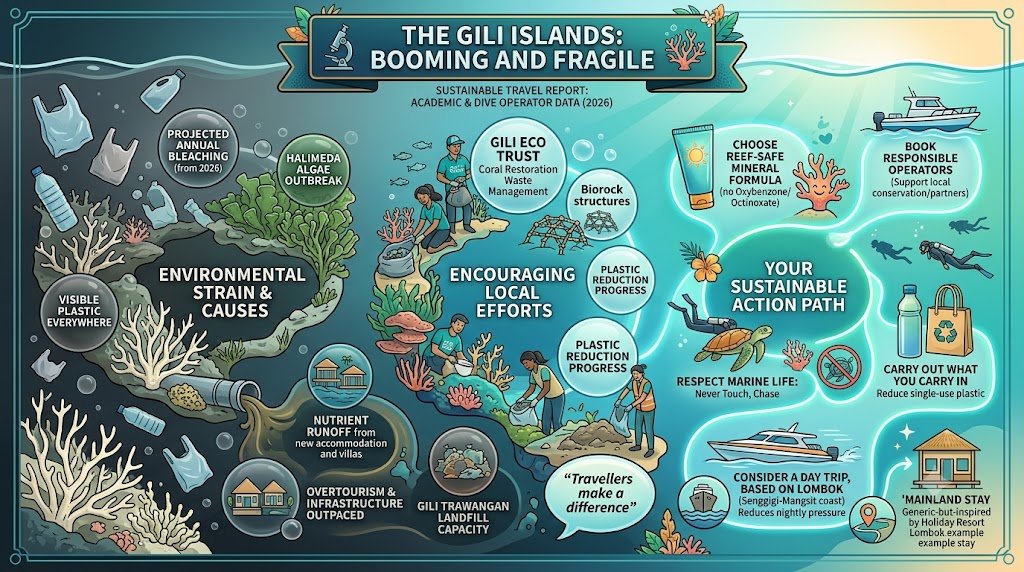
The clearest sign is underwater. Researchers project annual coral bleaching starting from 2026 around the Gilis, and dive operators have documented a growing outbreak of Halimeda algae — a fast-spreading, calcifying green algae that thrives when a reef is receiving more nutrients than it can handle, usually from wastewater and runoff. One dive operator on Gili Trawangan put it bluntly: “The corals are bleached, and plastic pollution is visible everywhere.”
Where the pressure is coming from
It is not one single cause. New accommodation, villas and resorts have gone up across Senggigi and the Gilis at a pace that has outrun the water and waste systems underneath them. Gili Trawangan, the busiest of the three islands, has an open-air landfill sitting in its center-north — a visible symptom of a waste system built for a much smaller number of visitors than the island now receives each year.
- More development, faster — accommodation supply has grown quicker than sewage and waste infrastructure.
- Nutrient runoff — wastewater feeding algae outbreaks that outcompete coral for space and light.
- Visible plastic — a persistent issue despite years of local clean-up efforts.
- Landfill capacity — waste volumes on Gili Trawangan have outgrown the island’s own disposal systems.
The part that is genuinely encouraging
This is not a story with no good news in it. Organisations like the Gili Eco Trust have worked for years on coral restoration and waste management across the islands, and the same research pointing to the problem also notes real local effort behind the response. Plastic reduction has made measurable progress even as new pressures emerge — it is a genuine fight, not a lost cause, and travellers who choose their operators and habits carefully make a real difference to which way it goes.
What you can actually do about it
- Choose reef-safe sunscreen — mineral formulas without oxybenzone or octinoxate, both linked to coral stress.
- Book with dive and snorkel operators who visibly support local conservation, including Gili Eco Trust partners.
- Never touch, stand on, or chase marine life — including the turtles the islands are famous for.
- Carry out what you carry in, and support businesses that have visibly reduced single-use plastic.
- Consider a day trip instead of an overnight stay if you are visiting in peak season — basing yourself on the mainland reduces the nightly load on island infrastructure while still giving you the reef and the turtles.
That last point is worth expanding on. Plenty of travellers now treat the Gilis as a brilliant day out rather than a place to sleep — boats run regularly from Bangsal Harbour, and basing yourself on the Senggigi–Mangsit coast instead (established stays like Holiday Resort Lombok run on mainland infrastructure built for exactly this kind of visitor volume) still puts you in the water with the turtles by mid-morning, just without adding another night’s pressure to a system that is already stretched.
Frequently asked questions
Are the Gili Islands’ coral reefs actually in trouble?
Research points to real strain — researchers project annual coral bleaching from 2026 onward, alongside a growing Halimeda algae outbreak linked to nutrient runoff from rapid development.
Is it still worth visiting the Gili Islands?
Yes — the reefs and turtles remain a genuine highlight. Travelling thoughtfully (reef-safe sunscreen, responsible operators, no touching marine life) makes a real difference to which direction things go.
What is being done to protect the Gili Islands’ environment?
Organisations including Gili Eco Trust have worked for years on coral restoration and waste management, and plastic reduction has made measurable progress even as new development pressures emerge.
Sources: Societies (MDPI) — peer-reviewed study · Oceans 5 Dive · Gili Eco Trust