

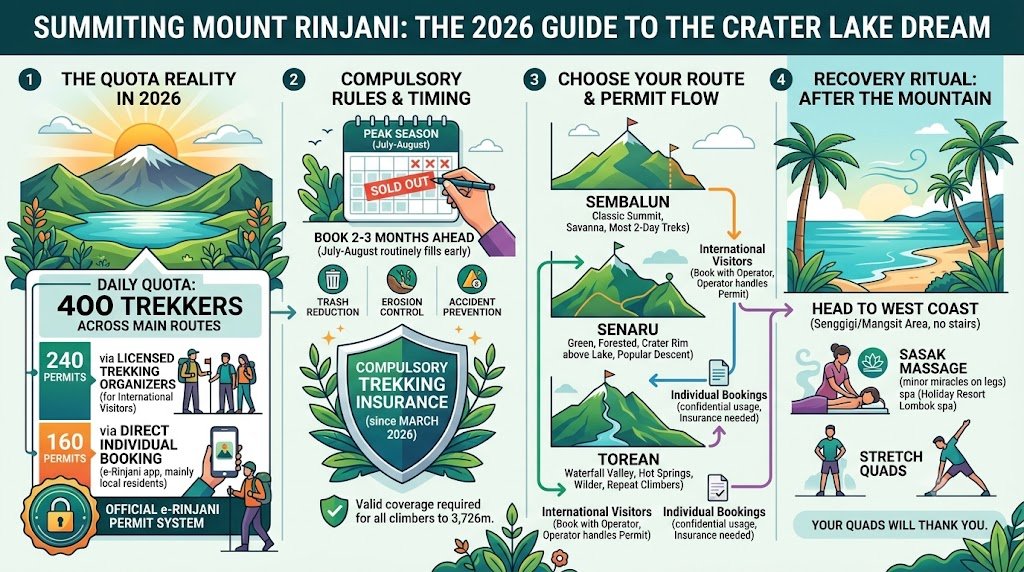
Dreaming of sunrise above Rinjani’s crater lake? So is everyone else — and in 2026, that dream comes with a quota. The new Mount Rinjani permit rules now limit climbers to 400 trekkers per day across its three main routes, permits are issued only through the official e-Rinjani system, and since March 2026, valid trekking insurance is mandatory. Here’s everything you need to know before you commit to Indonesia’s most famous volcano trek.
The Mount Rinjani permit rules at a glance
- Daily quota: 400 trekkers across the three main routes — Sembalun, Senaru and Torean.
- 240 permits go to licensed trekking organizers (this covers most international visitors, who must climb with a registered operator and guide).
- 160 permits are reserved for individual bookings made directly through the e-Rinjani app.
- Insurance is compulsory — since March 2026, every trekker must carry valid trekking insurance coverage.
- Peak season sells out fast — in July and August, permits routinely fill 2–3 months in advance.
Why the crackdown?
Rinjani earned its rules the hard way. Years of overcrowding left the mountain with trash problems, trail erosion and — more seriously — a string of accidents involving underprepared hikers. The quota system, compulsory registration and insurance requirement are the park authority’s answer: fewer people on the trail, every one of them accounted for, insured and (for internationals) guided. Annoying if you like winging it; excellent if you like mountains that stay beautiful and rescues that actually happen.
How to actually get a permit
For most international travellers the process is refreshingly simple: book with a licensed trekking operator, and they handle the e-Rinjani permit from their organizer allocation. Your job is to book early — for a July or August 2026 summit, reputable operators recommend locking in dates two to three months ahead — and to arrange trekking insurance that explicitly covers hiking to 3,726 metres.
Indonesian residents and confident independent hikers can book one of the 160 public slots directly in the e-Rinjani app, subject to the same insurance rule. Whichever route you take, the Mount Rinjani permit rules are enforced at the trailhead — rangers check permits and insurance documents before you set off, so this is not a box you can leave unticked and sort out later.
Which route should you choose?
- Sembalun — the classic summit route. Longer, more exposed, savanna views; most 2-day summit treks start here.
- Senaru — the greener, forested approach; often used as the descent leg, passing the crater rim above the lake.
- Torean — the wilder valley route past hot springs and waterfalls, increasingly popular with repeat climbers.
After the mountain
There’s a well-worn ritual among Rinjani trekkers: hobble off the mountain, head for the coast, and spend two days doing absolutely nothing. The west coast around Senggigi and Mangsit is the traditional recovery zone — flat, breezy and mercifully free of stairs — and a traditional Sasak massage works minor miracles on post-summit legs (the spa at beachfront Holiday Resort Lombok in Mangsit specialises in exactly that). Your quads will thank you.
Booking around the Mount Rinjani permit rules
One practical wrinkle worth planning for: the 400-per-day cap means popular dates — weekends, the days either side of public holidays, and anything in late July or August — can be gone well before you’d expect. Operators generally recommend nailing down your Rinjani dates before booking the rest of your trip, then building your itinerary around them rather than the other way round. If your first-choice date is unavailable, most licensed operators can suggest the next open slot within a day or two, since demand is rarely evenly spread through the week. Midweek departures in particular tend to have the most flexibility.
Frequently asked questions
How many people can climb Rinjani per day in 2026?
400 in total: 240 permits via licensed trekking organizers and 160 via direct individual booking on the e-Rinjani app.
Is insurance really required to climb Rinjani?
Yes. Since March 2026, all trekkers must hold valid trekking insurance to receive a permit.
How far in advance should I book a July or August trek?
Two to three months. The daily quota fills fastest in peak season (June–August) and around public holidays.
Can I climb Rinjani without a guide?
International visitors are expected to climb with a licensed operator and guide; the independent e-Rinjani allocation is aimed at local hikers. Either way, everyone needs a permit and insurance.
Sources: Green Rinjani — e-Rinjani Permit Guide · Green Rinjani — Trekking Rules 2026 · Lombok Agent — Trekking Regulation 2026