

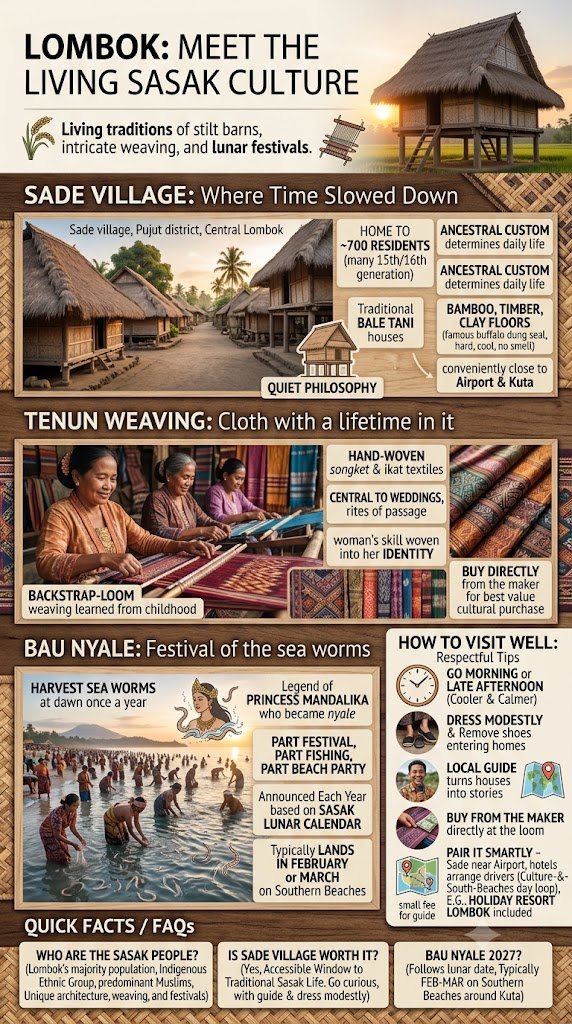
Understanding Sasak culture Lombok-wide is what turns a beach trip into something richer: beaches bring people here, but the Sasak keep them curious. The island’s indigenous people — the overwhelming majority of its population — have held onto a living culture of stilt-legged rice barns, hand-woven textiles and lunar-calendar festivals that turns any Lombok trip into more than a beach holiday. Here’s how to meet it respectfully, starting with the island’s most famous village.
Sade: the village where time slowed down
In the Pujut district of Central Lombok — conveniently close to the airport and Kuta — the village of Sade houses around 700 residents, many of them the 15th or 16th generation of the same families, living by ancestral custom. The traditional bale tani houses are built of bamboo and timber with clay floors famously polished with buffalo dung — a natural sealant that keeps them hard, cool and insect-free (and no, they don’t smell). The name ‘Sade’ itself is linked to a Sasak word for medicine or consciousness — a village as its own quiet philosophy.
Tenun: cloth with a lifetime in it
Sasak girls traditionally learn tenun — backstrap-loom weaving — from childhood, and in weaving villages like Sade you’ll watch intricate songket and ikat textiles emerge thread by thread. These aren’t souvenirs invented for tourists; songket is ceremonial wear, central to weddings and rites of passage, and a woman’s weaving skill has long been woven (literally) into her identity. Buying a piece directly from the weaver is the single best-value cultural purchase on the island.
Bau Nyale: the festival of the sea worms
Once a year, by the Sasak lunar calendar (usually February–March), thousands descend on Lombok’s southern beaches at dawn to harvest nyale — sea worms whose annual spawning is tied to the legend of Princess Mandalika, who threw herself into the sea rather than choose between suitors and, the story goes, returns as the nyale. It’s part festival, part fishing expedition, part all-night beach party — and it gave the Mandalika area its name.
Sasak culture Lombok: how to visit well
- Go morning or late afternoon — cooler for you, calmer for the village.
- Dress modestly and remove shoes when entering homes; a local guide (small fee) turns houses into stories.
- Buy from the maker — weavings bought at the loom put money exactly where it belongs.
- Pair it smartly — Sade sits minutes from the airport road, making it a perfect first or last stop on any itinerary; west-coast hotels along Senggigi–Mangsit (Holiday Resort Lombok included) arrange drivers for a culture-and-south-beaches day loop.
Language and everyday Sasak culture Lombok travellers encounter
Most Sasak speak Bahasa Sasak at home and Bahasa Indonesia more widely, and a few words go a long way with hosts and weavers alike: tampi asih (thank you, in Sasak) tends to earn a genuine smile where the more common Indonesian terima kasih gets a polite nod. Village life still runs on visible daily rhythm — the call to prayer marking the day’s structure, women weaving on verandas in the cooler morning hours, men heading to rice fields at dawn — and simply noticing and respecting that rhythm, rather than treating a village as a photo backdrop, is most of what “visiting well” actually means in practice.
Markets are another easy, low-pressure way to encounter Sasak culture Lombok-wide without a formal village tour: Sunday markets in smaller towns mix produce, textiles and street food, and bargaining is expected but should stay good-natured — a small discount matters far less to your trip than it does to the seller’s day, so haggle lightly and know when to simply pay the asking price.
Frequently asked questions
Who are the Sasak people?
Lombok’s indigenous ethnic group and the vast majority of the island’s population — predominantly Muslim, with distinct architecture, weaving traditions and festivals like Bau Nyale.
Is visiting Sade village worth it?
Yes — it’s the most accessible window into traditional Sasak life, ten minutes from the airport road. Go with genuine curiosity, a guide and modest dress, and it rewards you many times over.
When is Bau Nyale 2027?
The date follows the Sasak lunar calendar and is announced by local authorities each year, typically landing in February or March on the southern beaches around Kuta.
Sources: Invest Islands — Sade Village · The Lombok Lodge — Sasak Culture · Lombok.com
[…] story leaves you wanting to see more of the culture behind it, it doesn’t stop at Mandalika. Sasak traditions run right across the island, and a good number of visitors build a slower cultural leg into their trip on the west coast too […]